The Hashimoto's Disease Diet: A 90-Day Root Cause Protocol
The Hashimoto's disease diet, done properly: a staged 90-day elimination and reintroduction protocol built on what the research actually shows.
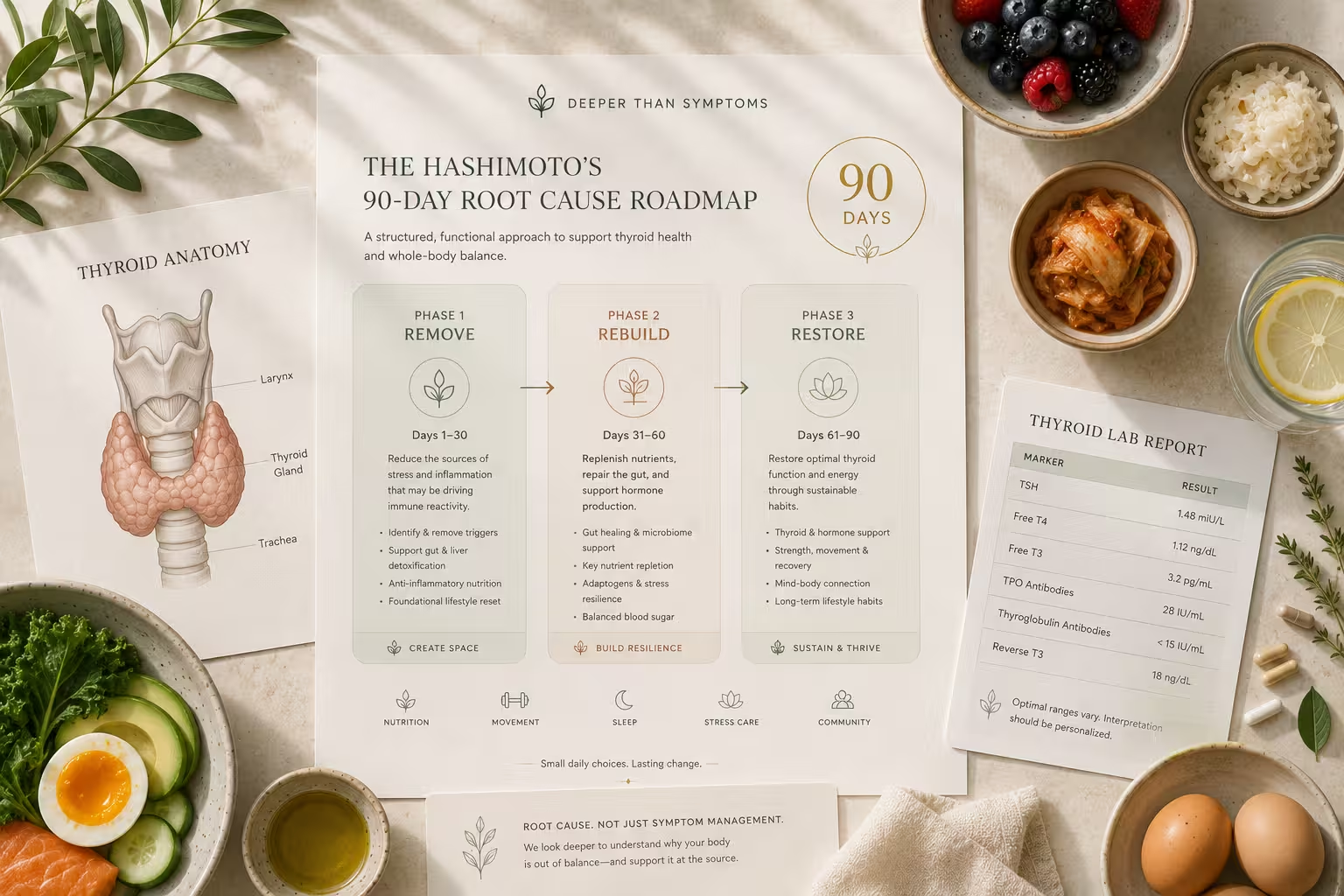
The Hashimoto's Disease Diet: A 90-Day Root Cause Protocol
If you've just been diagnosed and you've spent the last week reading food lists, you've probably noticed something frustrating. One site says gluten is the enemy. Another says dairy. A third bans nightshades, soy, and eggs. By the time you finish, you're staring at a kitchen you're afraid to cook in.
Here's what almost nobody tells you. The most rigorous research on the Hashimoto's disease diet is messier than any of those lists suggest. It's also far more interesting.
A 2025 systematic review in Nutrients pooled the randomized trials on gluten-free eating in people who have Hashimoto's but not celiac disease. The result? Thyroglobulin antibodies dropped. But thyroid peroxidase antibodies actually went up. TSH, free T3, and free T4 barely moved. The authors rated their own certainty as very low — three trials, 110 people total (DOI: 10.3390/nu17213437).
Read that again, because it reframes the whole project. This isn't a reason to give up on dietary change. It's a reason to stop treating your antibody count as the scoreboard — and to build a Hashimoto's diet that measures what actually matters.
Why Most Hashimoto's Diet Advice Falls Short
The standard Hashimoto's disease diet — a long list of banned foods handed to you on day one — fails for three big reasons.
It removes everything at once. Cut gluten, dairy, soy, eggs, grains, legumes, nightshades, and sugar on the same Monday, feel better by Friday, and you've learned that something helped. You have no idea what. Six months later you're still avoiding all of it, out of fear rather than evidence.
It has no baseline. Without a written record of how you felt before you started, "I think I have a bit more energy?" isn't data. It's hope, and hope fades by week three.
It measures the wrong thing. Two separate studies found the same strange pattern. In the gluten-free meta-analysis, and again in a 12-week trial of the Autoimmune Protocol, people reported feeling clearly better — while anti-TPO rose. The Autoimmune Protocol trial ran in Annals of Agricultural and Environmental Medicine. Symptoms of malaise dropped. Thyroid volume shrank. Antibodies still climbed (DOI: 10.26444/aaem/166263).
Thyroid antibodies reflect immune activity. They don't track how you feel, and they're a poor short-term report card for food changes.
So what should you measure? Sleep. Energy at 3pm. Brain fog, joint aches, digestion, hair, cold tolerance, mood. The things that sent you looking for answers in the first place.
The Three Rules Behind This Hashimoto's Diet Protocol
These matter more than any food list:
- Fix absorption before you fix inflammation. A thyroid diet that ignores how your medication and nutrients get absorbed is building on sand.
- Remove in sequence, not all at once. One variable at a time is slower. It's also the only way you learn something you can keep.
- Reintroduce deliberately. Elimination is a diagnostic tool with an expiry date. A permanent restriction you never tested isn't a protocol — it's anxiety with a grocery list.
The 90-Day Protocol
Phase 0 — Week 0: Build Your Baseline
Before you change a single meal, spend seven days recording what "normal" currently looks like.
- Score six symptoms daily, 1–10: energy, brain fog, digestion, joint pain, mood, sleep quality
- Photograph one week of meals — you'll be surprised what you don't remember eating
- Note your current labs: TSH, free T4, free T3, TPO antibodies, plus ferritin, vitamin D, and B12 if you have them
- Write down your one biggest complaint — the symptom you'd most want gone in 90 days
Don't skip this week. It's the highest-leverage part of the protocol, and it's the part everyone skips.
Phase 1 — Weeks 1–2: Absorption and the Nutrient Floor
Nothing else in a Hashimoto's disease diet works well if this layer is broken.
If you take levothyroxine: take it on an empty stomach and leave a gap before food. Keep calcium, iron, and magnesium supplements at least four hours from your dose. Coffee too close to the tablet can blunt absorption. Whatever routine you land on, be consistent — an erratic schedule makes your thyroid labs unreadable.
Then fill the nutrient gaps that have real evidence behind them. A 2024 meta-analysis in Thyroid pooled 35 randomized trials. Selenium lowered TPO antibodies. In people not yet on thyroid hormone replacement, it lowered TSH too. A 2025 meta-analysis of 21 trials in Medicine found the same direction of effect at three and six months. Food first is the smart way in. Selenium is rich in Brazil nuts, sardines, eggs, and sunflower seeds — two Brazil nuts a day gets you there (DOI: 10.1089/thy.2023.0556).
Vitamin D is worth testing rather than guessing. A 2025 review in Frontiers in Endocrinology looked at vitamin D supplementation in Hashimoto's. It cut antibodies — but only in people who started out truly low, under 20 ng/mL. If your vitamin D is already adequate, more won't help. So test before you buy (DOI: 10.3389/fendo.2025.1576850).
Iodine deserves real caution. More is not better in autoimmune thyroid disease, and high-dose iodine supplements can worsen thyroid function. Discuss it with your practitioner before touching it (see our guide on subclinical hypothyroidism and optimal TSH ranges).
Phase 2 — Weeks 3–8: Structured Elimination
Now — and only now — start removing foods. In this order, two weeks apart.
Weeks 3–4: gluten only. Keep everything else identical and score your symptoms daily. This is the single most-studied change in the Hashimoto's diet literature, and the one most likely to reveal something real.
Weeks 5–6: add dairy. Same rules. Milk proteins are a common secondary trigger, and lactose can interfere with levothyroxine absorption in some people.
Weeks 7–8: add refined sugar and alcohol. Both drive blood-sugar swings and inflammation. Both are far easier to test than the exotic cuts people jump to first.
Notice what's not here: nightshades, eggs, legumes, grains. The Autoimmune Protocol, or AIP, cuts all of them. The evidence for that much restriction in Hashimoto's is one small AIP study of 28 people. The Autoimmune Protocol may turn out to be right for you. But it's a later conversation with a practitioner, not a starting point.
Phase 3 — Weeks 9–12: Reintroduce, One at a Time
This is the phase that separates a Hashimoto's diet protocol from a punishment.
Reintroduce one food group at a time. Eat a normal portion, twice a day, for three days. Then wait four days before you test the next one. Track symptoms the whole time. Delayed reactions are common — a Tuesday reintroduction can surface as a Thursday headache.
Keep the removals that clearly earn their place. Bring back everything else. A Hashimoto's disease diet you can sustain for ten years beats a perfect one you abandon by March.
What to Expect, Honestly
Everyone wants to know how fast a Hashimoto's diet works. Here's the realistic timeline. Weeks 1–2 can feel worse before better, especially if you're cutting sugar. Digestive changes usually show first, around weeks 2–4. Energy and brain fog tend to shift later, closer to weeks 6–10.
If you corrected a low vitamin D or added selenium in Phase 1, those levels move on their own timeline — usually 8–12 weeks. Thyroid antibodies are the slowest and least reliable marker of all. Don't retest them at 90 days, and don't panic if they've risen — remember what both trials found. Standard practice is to recheck thyroid function three months after any meaningful change, with your practitioner.
Healing isn't linear. A bad week isn't failure.
Four Mistakes That Derail a Hashimoto's Diet
- Changing medication timing and food in the same week. You lose the ability to attribute anything to anything.
- Chasing antibody numbers. They lag, and they're noisy. A poor guide to whether your food changes are working.
- Going gluten-free by substitution. Swapping bread for packaged gluten-free bread usually means more refined starch and fewer nutrients.
- Never reintroducing. The most common failure mode by far. Restriction quietly becomes permanent, and dietary variety — which your gut microbiome depends on — collapses (read our deep dive on functional medicine and gut health).
When to Bring in a Practitioner
A Hashimoto's disease diet is safe to trial on your own for most people. Not for everyone, though. Bring in a practitioner if any of these apply:
- You're pregnant or trying to conceive
- You have another autoimmune diagnosis
- You're losing weight without meaning to
- Celiac disease hasn't been ruled out
- Your symptoms worsen at any point
Get celiac testing done before you go gluten-free — the test needs gluten in your system to be accurate. This is a common and expensive mistake.
Frequently Asked Questions
Does a gluten-free Hashimoto's disease diet help if I don't have celiac disease?
How long before I notice a difference?
Do I have to follow the Autoimmune Protocol?
Should I take selenium?
Can a Hashimoto's diet reverse the condition?
Your Next Step
Pick a start date. Then do Phase 0 — just the seven days of baseline tracking, before you change a single thing you eat.
Want it laid out for you already? Download our free Hashimoto's 90-Day Reset Guide — a printable step-by-step PDF roadmap with the daily symptom tracking sheet, staged elimination calendar, and thyroid lab checklist to bring to your practitioner.
Your body isn't broken. It's responding to something — and this is how you find out what.
Hashimoto's 90-Day Reset Guide
Download our free Hashimoto's 90-Day Reset Guide — a step-by-step PDF roadmap for baseline tracking, elimination sequencing, and nutrient optimization.
Download PDF FreeFact Checked By Dr. Prerana Suryawanshi, MBBS
This medical analysis has been peer-reviewed and vetted by a credentialed practitioner to ensure diagnostic safety.

Written by Dr. Pooja, PharmD
Dr. Pooja didn't set out to write about gut health and hormones. She set out to become a pharmacist — learning how drugs move through the body, why they interact the way they do, and what it actually takes to prove a treatment works. That training is still the lens she writes through today.
View all articles by Dr. Pooja