What Causes Low Progesterone? It's Rarely About Progesterone
What causes low progesterone? Almost always, an ovulation problem — driven by stress, under-eating, PCOS, thyroid, prolactin, or perimenopause. Here's the chain.
On this page Read more
- Where progesterone actually comes from
- Regular periods don't prove you ovulated
- What causes low progesterone: six upstream drivers
- How the drivers connect
- Low progesterone symptoms: what the pattern looks like
- Testing: why the day 21 progesterone test misleads
- How to increase progesterone naturally, by fixing ovulation
- When to see someone
- Where this leaves Priya, and you
- Frequently Asked Questions
- References
Reading time: ~12 min | Medically reviewed by Dr. Prerana Suryawanshi, MBBS | Last reviewed: September 2026
A client I'll call Priya had a 28-day cycle you could set a calendar by. She also had a day-21 progesterone result of 2.1 ng/mL, a diagnosis of "low progesterone," and a prescription for a cream.
Nobody had asked the one question that mattered. Had she actually ovulated that month?
If you've been handed a result like hers, you're probably asking what causes low progesterone. Most pages answer with a list — stress, PCOS, thyroid, perimenopause — as if these were six unrelated ways for a hormone to run short. They aren't. They're six ways to interrupt one event. Almost every case of low progesterone traces back to an ovulation that was weak, late, or didn't happen at all.
Once you see that, the whole picture reorganizes itself. Let's walk up the chain together.
This post is for educational purposes only. It isn't medical advice, and it isn't a substitute for working with a qualified practitioner.
Where progesterone actually comes from
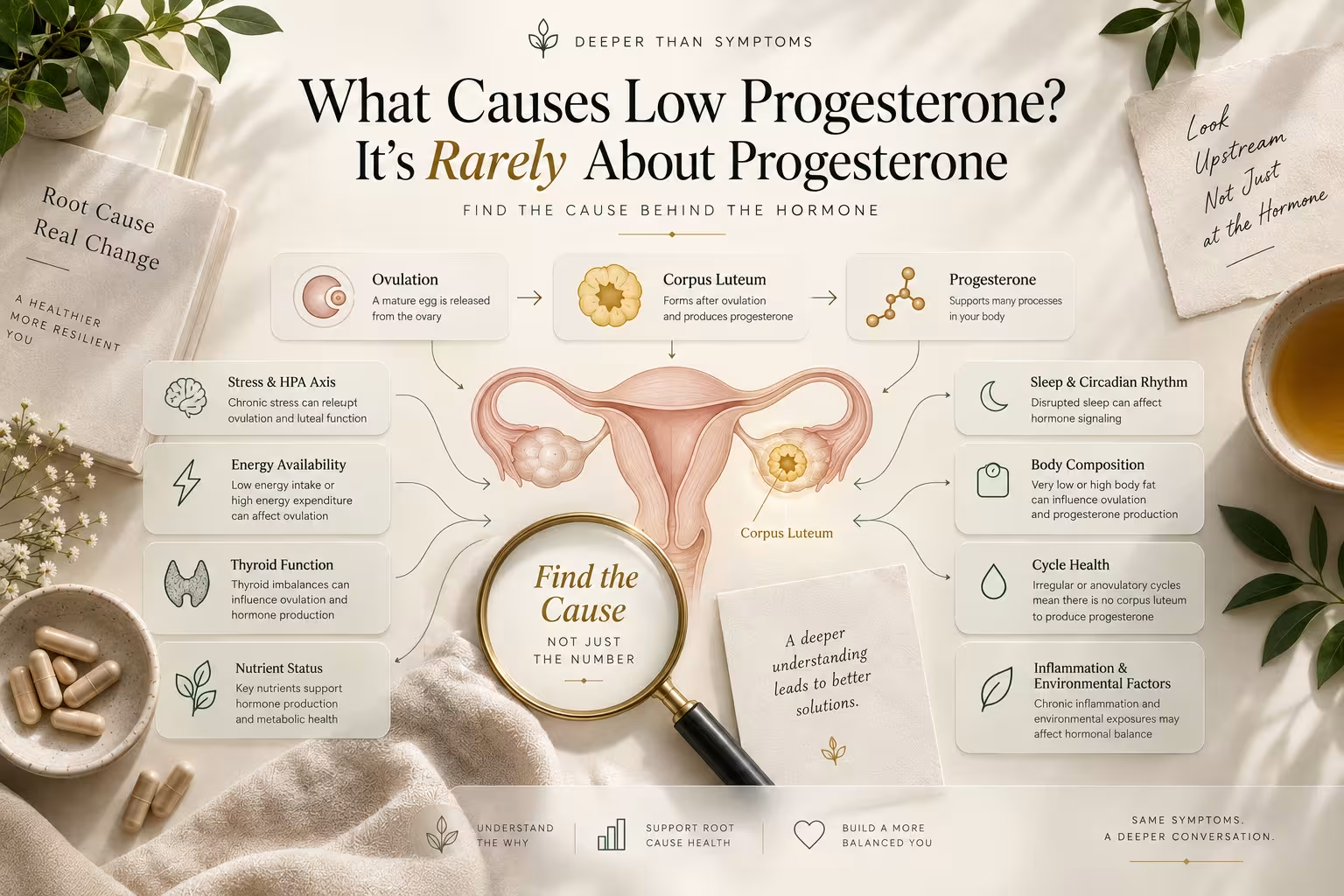
Low progesterone is caused by weak or absent ovulation. Progesterone is made almost entirely by the corpus luteum, the temporary gland that forms from the follicle after it releases an egg. No ovulation means no corpus luteum, and no corpus luteum means no meaningful progesterone. A weak ovulation builds a weak corpus luteum, which makes less progesterone for fewer days.
Hold onto that one fact. Everything else about low progesterone follows from it.
Here's the sequence. In the first half of your cycle, a follicle grows under the direction of FSH and produces estrogen. A surge of LH triggers ovulation. What's left of the follicle collapses, fills with blood vessels, and becomes the corpus luteum. That little gland pumps out progesterone for roughly 12 to 14 days. If no pregnancy tells it to keep going, it dissolves. Progesterone levels fall, and you bleed. (Cleveland Clinic)
So progesterone isn't a hormone your body stocks. It's a hormone your body earns, every single cycle, by ovulating well. The corpus luteum is the factory. Ovulation is the act of building it. When someone asks what causes low progesterone, the honest first answer is this: something upstream stopped the factory from being built properly.
Before we get to what that something might be, we need to clear up an assumption that trips up almost everyone. Including Priya's doctor.
Regular periods don't prove you ovulated
Most of us treat a monthly bleed as proof of a monthly ovulation. So do many clinicians. The data say otherwise.
In 2015, endocrinologist Jerilynn Prior and her team published a population study in PLOS ONE, drawn from the HUNT3 health survey in Norway. They measured a single serum progesterone in 3,168 women with clinically normal, normal-length cycles. Median cycle: 28 days. Nobody on hormonal contraception. Among the 1,545 women whose sample fell in the expected luteal window, 37% were anovulatory. Their progesterone levels averaged 3.8 nmol/L against 24.5 in the women who'd ovulated. And the two groups didn't differ in age, weight, exercise, or self-reported health. (Prior et al., PLOS ONE, 2015)
Read that again. More than a third of "normal" cycles, in a random population, produced no corpus luteum at all.
How is that possible? Because bleeding doesn't require ovulation. Estrogen alone builds the uterine lining. When estrogen dips, or the lining simply outgrows its blood supply, you shed it on schedule. Egg or no egg. From the outside, an anovulatory cycle and an ovulatory one can look identical. From the inside, one made progesterone and one didn't.
That's why low progesterone symptoms so often show up in women whose cycles "look fine." And it's why the causes of low progesterone are really the causes of anovulation. Or of luteal phase deficiency, the clinical term for a corpus luteum that forms but underperforms. Six drivers account for most cases of low progesterone.
What causes low progesterone: six upstream drivers
Each of these interrupts ovulation at a different point in the chain. Some hit the brain's signal. Some hit the ovary's response. Some shorten the corpus luteum's working life. Most people have more than one.
1. Chronic stress, and why the "pregnenolone steal" gets it wrong
Stress and low progesterone are linked. That part is true and well supported. The explanation you'll read on most wellness sites is not.
The popular version goes like this. Your body makes both cortisol and progesterone from pregnenolone. Under chronic stress it "steals" pregnenolone to make cortisol, so there's none left for progesterone. It's a tidy story. It's also wrong on the biochemistry.
Cortisol is made in your adrenal glands. Progesterone, in a cycling woman, is made in the corpus luteum of the ovary. They draw on separate cholesterol pools, inside separate cells, in separate organs. There's no shared bucket for one to drain.
The real mechanism is upstream, in the brain, and it's better evidenced. Chronic stress signalling dampens the pulsing release of GnRH from the hypothalamus. Weaker GnRH pulses mean weaker LH pulses. Weaker LH pulses mean a weaker ovulation, or none at all. And that means a weaker corpus luteum, or none at all. The stress response and the reproductive axis share the same control room. Read more in HPA axis dysfunction symptoms: what they really mean.
Here's what that looks like in real women. In 2015, an NIH team led by Karen Schliep followed 259 healthy women aged 18 to 44 across two full cycles. Daily stress diaries, repeated hormone sampling. The results, published in Epidemiology, were specific. Women reporting high daily stress had 14.8% lower LH, 10.4% lower luteal progesterone, and roughly twice the odds of an anovulatory cycle. Every one-unit rise in daily stress raised the odds of anovulation by 70%. These were women with no known reproductive disorder. (Schliep et al., Epidemiology, 2015)
So the link between stress and low progesterone is real. The "steal" is not. The distinction matters because it changes where you intervene. You don't need to protect a pregnenolone supply. You need to lower the alarm signal reaching your hypothalamus. That's a nervous-system project, not a supplement.
Signs stress is behind your low progesterone: cycles that lengthen or vanish during hard seasons, a luteal phase that has quietly shortened, sleep that doesn't restore, and the wired-but-tired pattern.
2. Under-fuelling: too little food, too much training
Your brain runs a constant audit. Is there enough energy here to sustain a pregnancy? When the answer is no, it does exactly what stress does. It slows the GnRH pulse. This isn't a disorder. It's a design feature, and it's remarkably sensitive.
In a 2003 study in the Journal of Clinical Endocrinology & Metabolism, Anne Loucks and Jean Thuma took 29 regularly menstruating women and set their energy availability at different levels for five days. Supervised exercise. Controlled diets. LH pulsatility held steady until energy availability dropped below 30 kcal per kilogram of lean body mass per day. Below that line, LH pulses slowed and turned erratic. The disruption was worse in women who already had a short luteal phase. (Loucks & Thuma, JCEM, 2003)
A follow-up trial from Penn State pushed further. Over three cycles, Nancy Williams and colleagues randomised untrained women to exercise with a mild, moderate, or severe daily energy deficit. Menstrual disturbances rose in a dose-response pattern with the size of the deficit. Luteal phase defects, anovulation, missed cycles. Trouble began at a deficit of roughly 470 kcal a day. (Williams et al., Am J Physiol Endocrinol Metab, 2015)
That number matters, because 470 kcal is not an eating disorder. It's a skipped breakfast plus a spin class. It's a "clean eating" month during a busy quarter. Many women with low progesterone aren't under-eating in any way they'd recognise. They're simply spending more than they take in, week after week. And their hypothalamus has noticed.
Signs under-fuelling is behind your low progesterone: intense training or intermittent fasting, a luteal phase under 10 days, cycles that stretch or disappear when you're "being good," and cold hands, low libido, or a hunger you've learned to ignore.
3. PCOS: when ovulation is the exception, not the rule
Polycystic ovary syndrome is one of the most common causes of low progesterone. It's also one of the most under-recognised. A 2025 systematic review and meta-analysis in JCEM pooled 88 studies and more than 561,000 women. Global prevalence came out at roughly 10.9% by the Rotterdam criteria. About one woman in ten. (Amiri et al., JCEM, 2025)
PCOS and low progesterone travel together because the defining feature of PCOS is infrequent or absent ovulation. Excess androgens and, in most cases, insulin resistance disrupt follicle development. Follicles start to mature and stall. That's what the "cysts" on ultrasound actually are: arrested follicles, not true cysts. Without a dominant follicle, there's no LH surge, no ovulation, and no corpus luteum.
The result? Long, unpredictable cycles and chronically low progesterone. Stretches of 40, 60, or 90 days in which estrogen is present and progesterone levels sit near zero. The lining builds without opposition, which is why bleeding, when it comes, can be heavy and prolonged.
Signs PCOS is behind your low progesterone: cycles longer than 35 days or fewer than nine a year, acne or hair growth along the jaw and chest, thinning hair on the scalp, and weight that gathers at the waist and resists effort.
4. Thyroid dysfunction
Your thyroid sets the metabolic tempo for every cell. That includes the cells of your ovary and the neurons that release GnRH. When thyroid hormone runs low, ovulation slows with it.
A 2010 review in Endocrine Reviews by Krassas and colleagues laid out the pattern. Hypothyroidism is associated mainly with infrequent periods and reduced fertility. Both hypo- and hyperthyroidism shift sex hormone binding globulin and sex steroid levels. (Krassas et al., Endocrine Reviews, 2010) Low thyroid also tends to raise prolactin, which brings us to the next driver. And it slows the clearance of estrogen, tilting the estrogen-to-progesterone ratio further.
The hypothyroidism and progesterone link is easy to miss. A TSH inside the reference range is often read as "fine." Functional practitioners frequently look for a TSH closer to 1.0 to 2.0. They'll also check free T3, free T4, and thyroid antibodies before ruling the thyroid out. Normal isn't the same as optimal. If Hashimoto's is part of your picture, start with the Hashimoto's disease diet protocol.
Signs your thyroid is the driver: low progesterone alongside fatigue, feeling cold, dry skin, constipation, hair shedding, heavier or more spaced-out periods, or a family history of thyroid disease.
5. Elevated prolactin
Prolactin is the hormone that sustains breastfeeding. One of its jobs during lactation is to prevent ovulation. It does that by suppressing the kisspeptin neurons in the hypothalamus that drive GnRH release. Less GnRH, fewer LH pulses, no surge, no ovulation. A 2022 review in the International Journal of Molecular Sciences traced this pathway in detail. (Calik-Ksepka et al., Int J Mol Sci, 2022)
The problem is that prolactin can run high when you're not breastfeeding. Hypothyroidism raises it. So do certain medications, including some antidepressants, antipsychotics, and anti-nausea drugs. Chronic stress nudges it up. So can a small, benign pituitary growth. When prolactin climbs, it quietly brakes ovulation the same way, and progesterone drops with it.
This is one of the few causes of low progesterone with a specific herbal trial behind it. A 1993 randomised, placebo-controlled study in Arzneimittelforschung gave 20 mg of Vitex agnus-castus to women with luteal phase defects tied to mildly raised prolactin. After three months, prolactin release fell, shortened luteal phases normalised, and the luteal progesterone deficit resolved. In the Vitex group only. It was small, with 37 women completing, but it points to a real mechanism worth raising with a practitioner if prolactin is your driver. (Milewicz et al., Arzneimittelforschung, 1993)
Signs prolactin is behind your low progesterone: irregular or missing periods, milky nipple discharge when not breastfeeding, headaches or visual changes, and low libido.
6. Perimenopause, and what "estrogen dominance" really means
If you're in your forties, low progesterone in perimenopause is expected. But the pattern is more interesting than "hormones decline."
In 1996, Nadine Santoro and colleagues published a careful study in JCEM. They compared daily urinary hormones in perimenopausal women aged 43 and up against women in their twenties and thirties. The perimenopausal women had higher estrogen excretion, not lower. They also had higher FSH and LH, shorter follicular phases, and significantly lower luteal progesterone. The team's conclusion: altered ovarian function in perimenopause shows up as early as 43, and it includes high estrogen together with reduced luteal progesterone. (Santoro et al., JCEM, 1996)
This is the biological truth behind the phrase "estrogen dominance." It isn't a diagnosis, and it has no clinical definition. But in perimenopause specifically, estrogen dominance describes a real state. Estrogen that's high or erratic. Progesterone that has fallen because ovulation has become inconsistent, and the corpus luteum, when it forms, is less robust. The ratio has shifted. The symptoms of that shift are heavier periods, breast tenderness, broken sleep, and anxiety that seems to arrive from nowhere. For what actually helps at this stage, see perimenopause supplements: what the evidence supports.
Outside perimenopause, "estrogen dominance" is mostly another way of saying low progesterone. Estrogen usually isn't elevated. It just has nothing opposing it.
Signs perimenopause is behind your low progesterone: age 40-plus, cycles that shorten then scatter, heavier flow, new night sweats or 3 a.m. waking, and PMS that has turned the volume up.
How the drivers connect
These aren't six separate lists to tick off. The causes of low progesterone compound.
Under-fuelling raises cortisol and lowers thyroid hormone. Hypothyroidism raises prolactin. Chronic stress worsens insulin resistance, which worsens PCOS. Perimenopause makes every one of these hit harder, because the ovary has less reserve to compensate.
Picture a woman in her early forties who trains fasted, sleeps six hours, and has borderline thyroid antibodies. She isn't dealing with one cause of low progesterone. She's dealing with a system that has stopped prioritising ovulation, for reasons that, from its point of view, are sensible.
That framing matters. Your body isn't malfunctioning. It's responding to conditions. Change the conditions and, in most cases, the response changes too.
Low progesterone symptoms: what the pattern looks like
Progesterone shapes the second half of your cycle and quiets your nervous system. So low progesterone symptoms tend to cluster there:
- A short luteal phase, fewer than 10 days from ovulation to bleeding
- Spotting in the days before your period
- PMS that escalates: anxiety, irritability, or low mood that peaks premenstrually
- Poor sleep in the second half of the cycle, because progesterone's metabolite allopregnanolone is calming, and without it nights get restless
- Heavy or prolonged periods, from a lining that built without opposition
- Breast tenderness and bloating
- Difficulty conceiving or early loss, since the corpus luteum sustains the lining until the placenta takes over
No single item on this list is diagnostic. The pattern, plus a cycle that has changed, is what's worth investigating. For a deeper exploration of each sign and why lab tests so often miss them, see our comprehensive guide to low progesterone symptoms: 9 signs your body is sending.
Testing: why the day 21 progesterone test misleads
Priya's test was technically correct and practically useless. Here's why.
A day 21 progesterone test assumes you ovulated on day 14. Suppose you ovulated on day 18 instead. That's common in a 30-day cycle, and very common under stress. Day 21 then catches your corpus luteum at three days old, before progesterone has peaked. The result reads low even though your cycle may be fine.
The test should be timed for about seven days after ovulation, whenever that happened for you. That means confirming ovulation first, with cervical mucus, basal body temperature, or LH strips, and counting from there. The free Ovulation Confirmation Tracker walks you through all three signs.
Even then, a single number is a rough guide. In a 1984 study in the Journal of Clinical Investigation, Filicori and colleagues sampled blood every ten minutes for 24 hours. The women were in the mid- and late luteal phase. Progesterone levels swung from 2.3 to 40.1 ng/mL within minutes, pulsing in step with LH. Their conclusion was blunt. Single progesterone estimations in the mid- and late luteal phase do not accurately reflect corpus luteum adequacy. (Filicori et al., J Clin Invest, 1984)
This is also why the American Society for Reproductive Medicine defines luteal phase deficiency by a luteal phase of 10 days or fewer, not by a lab value. Its committee opinion, updated in 2021 and again in 2026, states plainly that no reproducible test reliably diagnoses luteal phase deficiency. (ASRM Practice Committee, Fertility and Sterility, 2021)
What a well-timed test can tell you: a mid-luteal progesterone above about 3 ng/mL confirms that ovulation happened. Progesterone levels in the range of 10 to 20 ng/mL suggest a healthy corpus luteum. Below that, with a confirmed ovulation date, is a genuine signal to look upstream. Some practitioners use a series of samples across the luteal phase, or urinary progesterone metabolite tracking, to see the shape rather than a snapshot.
So the sequence is: confirm ovulation, time the test, read it as a clue. Then ask what's interrupting the factory.
How to increase progesterone naturally, by fixing ovulation
If you've read this far, you already know the answer to "how to increase progesterone naturally." You don't. You increase ovulation, and progesterone follows. In practice, that means matching your first moves to your likely driver.
- Eat enough, consistently. Close the energy gap before anything else. Breakfast within an hour of waking, protein at every meal, and no fasted training while you're rebuilding. If you track, stay well clear of a daily deficit. The trial threshold for trouble was around 470 kcal.
- Lower the alarm signal. Ten minutes of daylight in the morning. A fixed sleep window. Some daily practice, whether that's breathwork or a walk, that tells your hypothalamus the emergency has passed. This is the intervention behind the Schliep data. See how to fix HPA axis dysfunction.
- Get the right labs. Ask for a full thyroid panel including antibodies, a morning prolactin, and fasting insulin. If cycles are long or androgens seem high, add testosterone and DHEA-S. These findings redirect the whole plan.
- Address insulin if PCOS is in the picture. Steady meals, resistance training, and adequate sleep move insulin sensitivity meaningfully. Some practitioners also use inositol. Discuss it with yours.
- Consider targeted botanicals, with guidance. Vitex has small-trial evidence for luteal phase defects tied to raised prolactin, and only that scenario is well studied. It isn't a general progesterone booster, and it interacts with hormonal medication.
- Know where bioidentical progesterone fits. In perimenopause, when ovulation is failing for reasons no lifestyle change reverses, cyclic progesterone is a reasonable conversation to have. Elsewhere, it treats the reading rather than the cause. And it can mask the signal you need.
Give any change two to three full cycles before you judge it. The follicle that ovulates this month started developing months ago. Healing here isn't linear, and it doesn't run on a 30-day timeline.
When to see someone
Book an appointment rather than experimenting if you have:
- No period for three months or more, and you're not pregnant or breastfeeding
- Milky nipple discharge, persistent headaches, or changes in vision
- Bleeding heavy enough to soak through protection hourly, or lasting more than seven days
- New hair growth on the face or chest, or rapid scalp hair loss
- Been trying to conceive for 12 months, or six months if you're 35 or older
- Early pregnancy losses
These aren't lifestyle problems. They need proper evaluation.
Where this leaves Priya, and you
Priya never used the cream. Three cycles of temperature tracking showed she was ovulating on day 19, not day 14. Her day-21 test had caught a corpus luteum barely two days old. Her real luteal phase was nine days. It lengthened to twelve once she stopped training fasted and started eating breakfast.
Her progesterone was never the problem. Her ovulation was. And her ovulation was responding to a body that felt under-resourced.
That's the shift in how to think about what causes low progesterone. It isn't a hormone that ran short. It's an ovulation that got interrupted, by stress, by under-fuelling, by PCOS, by thyroid or prolactin, or by the natural turbulence of perimenopause. Find the interruption and you've found the cause of your low progesterone.
Start with one thing. Confirm that you're ovulating, and when. Everything else builds on that.
The Ovulation Confirmation Tracker is a free, printable three-cycle log for temperature, mucus, LH, and luteal length, with a one-page guide to reading the pattern and timing your progesterone test. It's the baseline that makes any progesterone result readable.
Download the Ovulation Confirmation Tracker (PDF, 5 pages)
No email required. Print it, tape it inside the bathroom cabinet, and bring it to your next appointment.
Then tell me in the comments: which of the six drivers did you recognise yourself in? That's usually the place to start.
Frequently Asked Questions
What causes low progesterone in women who aren't pregnant?
Can stress cause low progesterone?
Why is my progesterone low if my periods are regular?
Is the day 21 progesterone test accurate?
Does PCOS cause low progesterone?
How can I increase progesterone naturally?
This content is for educational purposes only and is not intended to diagnose, treat, cure, or prevent any disease. Always consult a qualified healthcare practitioner before making changes to your health regimen, supplements, or medication.
Author: Dr. Pooja, PharmD | Medically reviewed by: Dr. Prerana Suryawanshi, MBBS
Last reviewed: September 2026
The Ovulation Confirmation Tracker
Download our free Ovulation Confirmation Tracker — a printable 3-cycle log for temperature, cervical mucus, LH, and luteal length to confirm whether and when you ovulated.
Download PDF FreeReferences
- Prior JC, Naess M, Langhammer A, Forsmo S. Ovulation Prevalence in Women with Spontaneous Normal-Length Menstrual Cycles — A Population-Based Cohort from HUNT3, Norway. PLOS ONE. 2015;10(8):e0134473. https://doi.org/10.1371/journal.pone.0134473
- Schliep KC, Mumford SL, Vladutiu CJ, et al. Perceived stress, reproductive hormones, and ovulatory function: a prospective cohort study. Epidemiology. 2015;26(2):177–184. https://doi.org/10.1097/EDE.0000000000000238
- Loucks AB, Thuma JR. Luteinizing hormone pulsatility is disrupted at a threshold of energy availability in regularly menstruating women. J Clin Endocrinol Metab. 2003;88(1):297–311. https://doi.org/10.1210/jc.2002-020369
- Williams NI, Leidy HJ, Hill BR, Lieberman JL, Legro RS, De Souza MJ. Magnitude of daily energy deficit predicts frequency but not severity of menstrual disturbances associated with exercise and caloric restriction. Am J Physiol Endocrinol Metab. 2015;308(1):E29–E39. https://doi.org/10.1152/ajpendo.00386.2013
- Amiri M, Hatoum S, Buyalos RP, Sheidaei A, Azziz R. The Influence of Study Quality, Age, and Geographic Factors on PCOS Prevalence — A Systematic Review and Meta-analysis. J Clin Endocrinol Metab. 2025;110(7):2082–2103. https://doi.org/10.1210/clinem/dgae917
- Krassas GE, Poppe K, Glinoer D. Thyroid function and human reproductive health. Endocr Rev. 2010;31(5):702–755. https://doi.org/10.1210/er.2009-0041
- Calik-Ksepka A, Stradczuk M, Czarnecka K, Grymowicz M, Smolarczyk R. Lactational Amenorrhea: Neuroendocrine Pathways Controlling Fertility and Bone Turnover. Int J Mol Sci. 2022;23(3):1633. https://doi.org/10.3390/ijms23031633
- Milewicz A, Gejdel E, Sworen H, et al. Vitex agnus castus extract in the treatment of luteal phase defects due to latent hyperprolactinemia: results of a randomized placebo-controlled double-blind study [German]. Arzneimittelforschung. 1993;43(7):752–756. PMID: 8369008
- Santoro N, Brown JR, Adel T, Skurnick JH. Characterization of reproductive hormonal dynamics in the perimenopause. J Clin Endocrinol Metab. 1996;81(4):1495–1501. https://doi.org/10.1210/jcem.81.4.8636357
- Filicori M, Butler JP, Crowley WF. Neuroendocrine regulation of the corpus luteum in the human: evidence for pulsatile progesterone secretion. J Clin Invest. 1984;73(6):1638–1647. https://doi.org/10.1172/JCI111370
- Practice Committee of the American Society for Reproductive Medicine. Diagnosis and treatment of luteal phase deficiency: a committee opinion. Fertil Steril. 2021;115(6):1416–1423. https://doi.org/10.1016/j.fertnstert.2021.02.010. Updated 2026: https://doi.org/10.1016/j.fertnstert.2026.06.014
- Cleveland Clinic. Low Progesterone: Causes, Symptoms, Tests & Treatment. https://my.clevelandclinic.org/health/diseases/24613-low-progesterone
Fact Checked By Dr. Prerana Suryawanshi, MBBS
This medical analysis has been peer-reviewed and vetted by a credentialed practitioner to ensure diagnostic safety.

Written by Dr. Pooja, PharmD
Dr. Pooja didn't set out to write about gut health and hormones. She set out to become a pharmacist — learning how drugs move through the body, why they interact the way they do, and what it actually takes to prove a treatment works. That training is still the lens she writes through today.
View all articles by Dr. Pooja